OBJECTIVE
Design a mobile-first product catalogue that acts as a learning and sales support tool, enabling staff to:
- Understand perfumes quickly
- Recall key information during sales
- Deliver structured pitches
- Navigate products intuitively
WHAT IS MYOP?
Make Your Own Perfume (MYOP) is a retail fragrance brand that offers customers a personalized perfume experience across multiple stores.
The brand focuses on helping customers discover, explore, and choose perfumes based on their preferences, rather than simply purchasing ready-made fragrances.
MYOP’s product range is divided into two key segments:
- Signature Collection – Everyday, accessible fragrances designed for a wide audience
- Luxury Collection – Premium, high-end perfumes with more complex scent profiles
Across both segments, perfumes are further categorized into groups like Fresh, Floral, Woody, and Oriental, making it easier to explore different scent families.
UNDERSTANDING OUR USERS
Ram
GOALS
- Learn perfumes quickly
- Avoid mistakes in front of customers
- Build confidence while selling
FRUSTRATIONS
Too many perfumes to remember. Forgets notes and pitch. Nervous during customer interaction.
NEEDS
Simple explanations, structured learning, and a quick recall system.
"I just want to learn quickly without feeling overwhelmed in front of customers."
Ajay
GOALS
- Sell faster and accurate recommendations
- Upsell premium perfumes
FRUSTRATIONS
Hard to remember all SKUs. No quick reference during rush hours. Training juniors takes too much time.
NEEDS
Fast navigation, quick comparisons, and an instant pitch reference.
"I need tools that speed up my flow, I don't have time to mentor during rush hours."
Punnya
GOALS
- Understand perfume profiles to create campaigns
- Communicate product benefits clearly
- Align messaging with sales teams
FRUSTRATIONS
No direct exposure to products. Relies on second-hand info. Hard to grasp fragrance differences without structured data.
NEEDS
Clear and structured product information, standardized descriptions, and a reliable source of truth.
"I need to understand the product clearly so I can communicate it right, even without being on the floor."
PROBLEM DEFINITION
Context: MYOP operates multiple retail stores where sales staff must quickly learn and confidently sell a wide range of perfumes.
Problem: New and existing sales staff struggle to:
- Remember fragrance notes and categories
- Deliver consistent sales pitches
- Understand differences between similar perfumes
- Recall key selling points under pressure
This leads to inconsistent customer experience, lower conversion rates, and longer training times.
Opportunity: Create a system that helps staff learn faster, recall instantly, and sell confidently.
KEY PROBLEMS
Information Overload
Too many perfumes, too much detail, no structure.
Poor Recall During Sales
Staff may learn initially, but cannot retrieve info quickly in real scenarios.
Inconsistent Sales Pitch
Each staff explains differently, leading to a complete lack of standardization.
Lack of Contextual Learning
Learning is not structurally tied to Category (Fresh, Woody, etc.), Use case (Day/Night), or Customer preference.
Training Dependency
Heavy reliance on senior staff and manual training sessions creates bottlenecks.
PRODUCT CATALOGUE AT A GLANCE
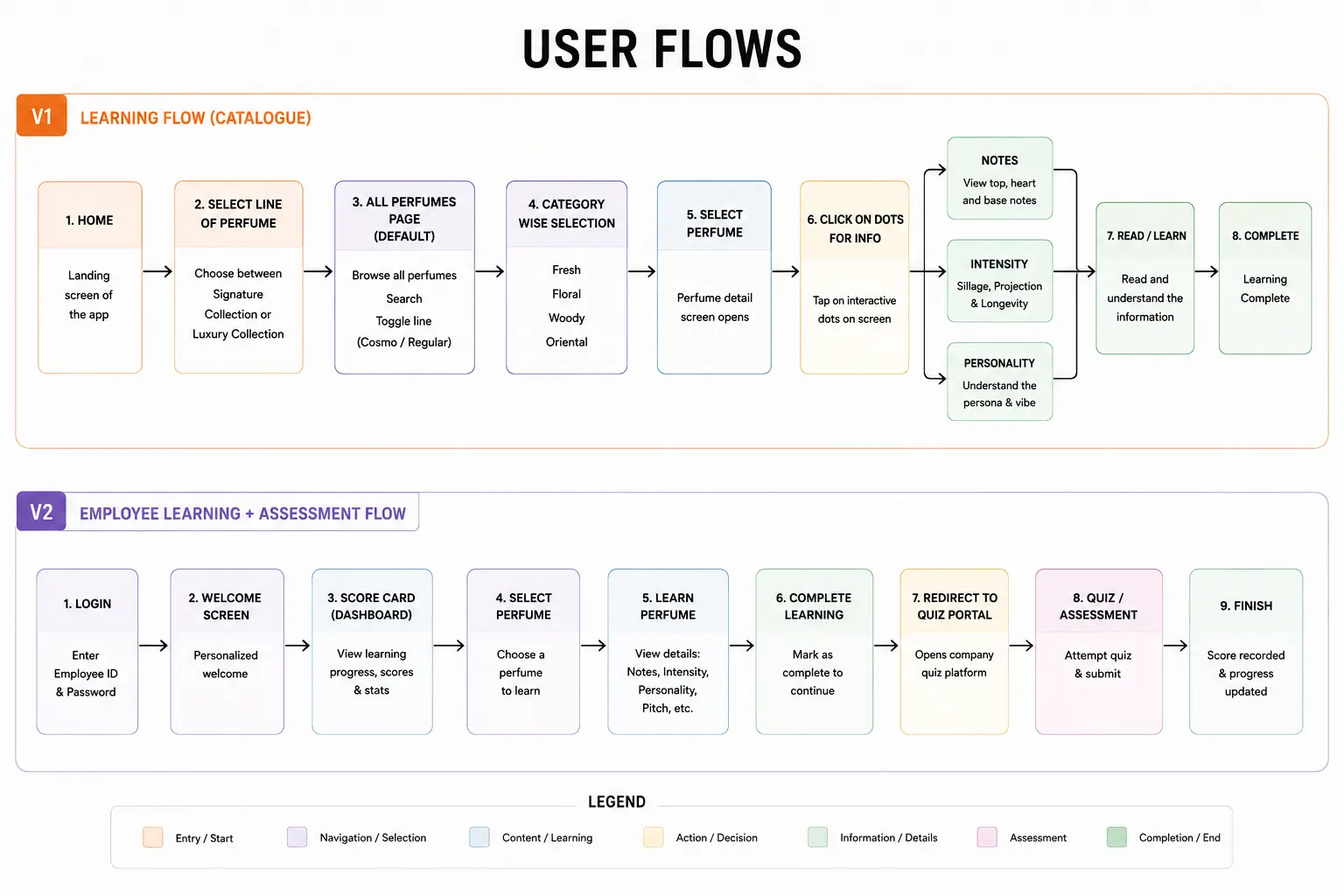
INFORMATION ARCHITECTURE
Two distinct user journeys were planned for the catalogue experience:
UX BREAKDOWN
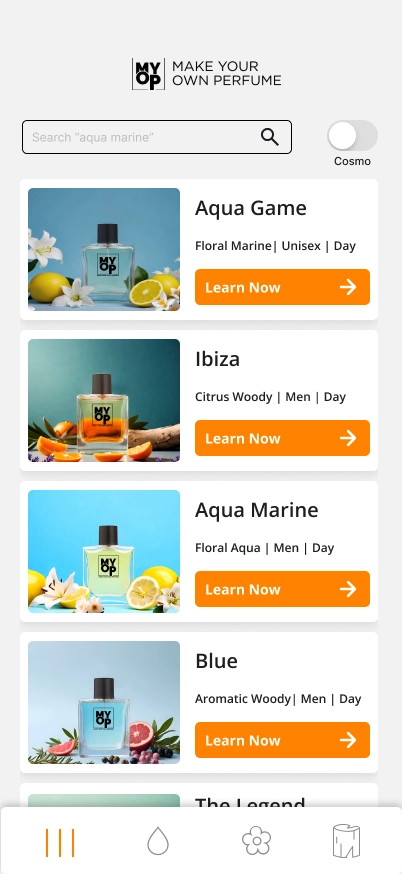
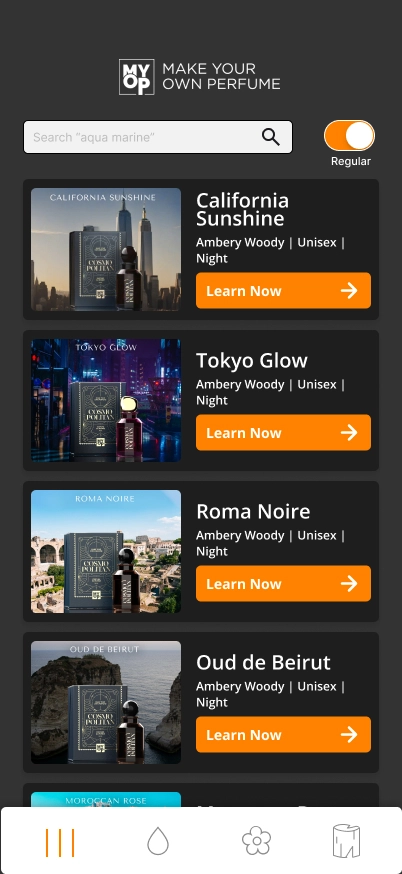
Search + Toggle
Search-first approach for quick recall during live selling.
Toggle between modes (e.g. Cosmo) to adapt to different customer preferences.
Card-Based Layout
Scannable cards with image + key tags (notes, gender, usage).
Helps staff identify perfumes in seconds without reading everything.
Information Hierarchy
Perfume Name → Notes → Context (Men / Day etc.)
Designed to mirror how sales staff speak to customers.
Action-Oriented CTA
“Learn Now” placed prominently.
Encourages quick transition from browsing → learning → selling.
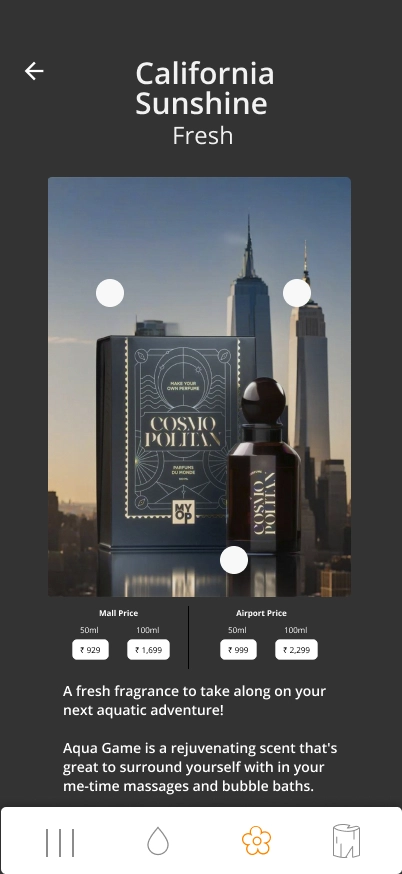
Pulsating Cues
Guide interaction intuitively across the screen.
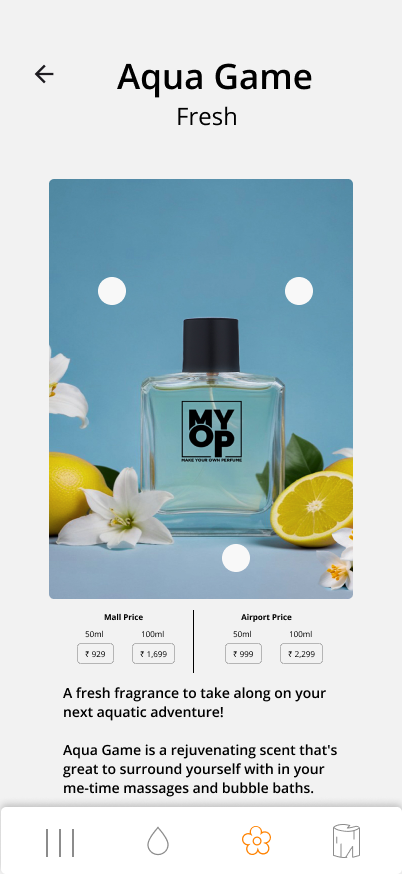
Tap-to-Reveal
Keeps the UI clean and avoids overwhelming the user with text.
Large Visual Aids
Enhances product recall quickly.
Category Label
Reinforces mental mapping of product ranges.
Pitch-First Content
Direct support for on-floor selling.
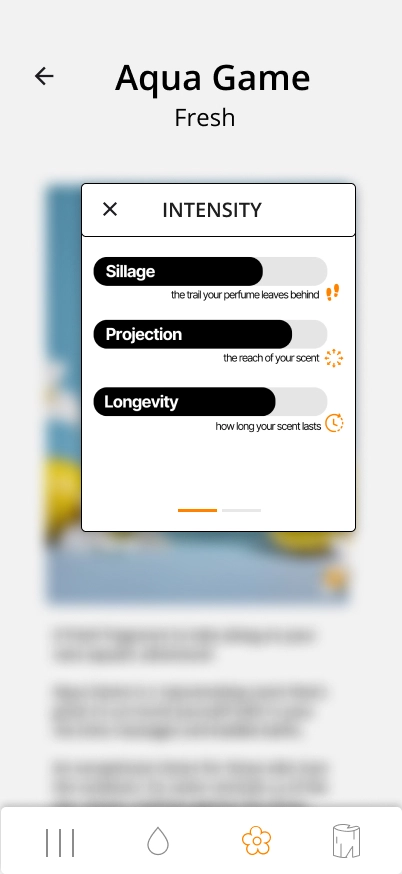
3 Simple Metrics
Breaks complexity down into chewable data.
Visual Bars
Enable instant comprehension without reading.
Micro-copy
Explains technical terms without jargon.
Overlay Context
Keeps the user in context without losing their place.
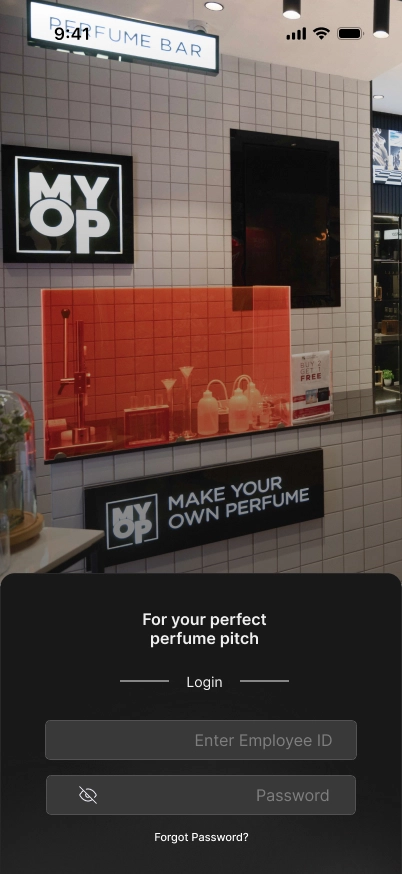
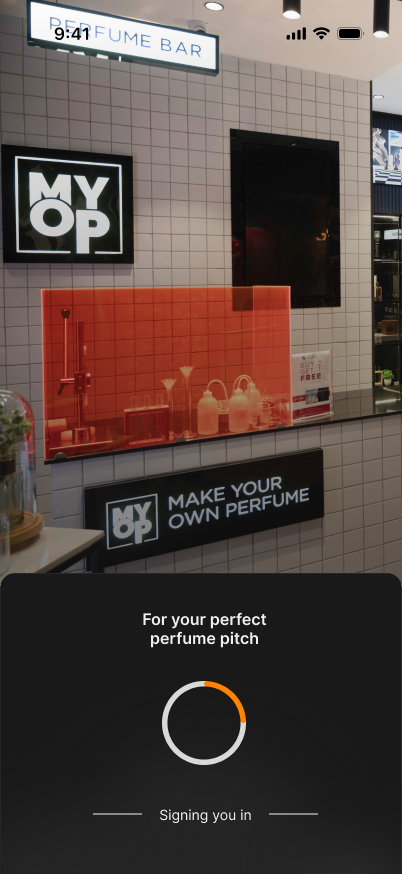
Real Store Visual
Builds context and familiarity instantly.
Clear Purpose
“Perfect perfume pitch” establishes the tool's goal.
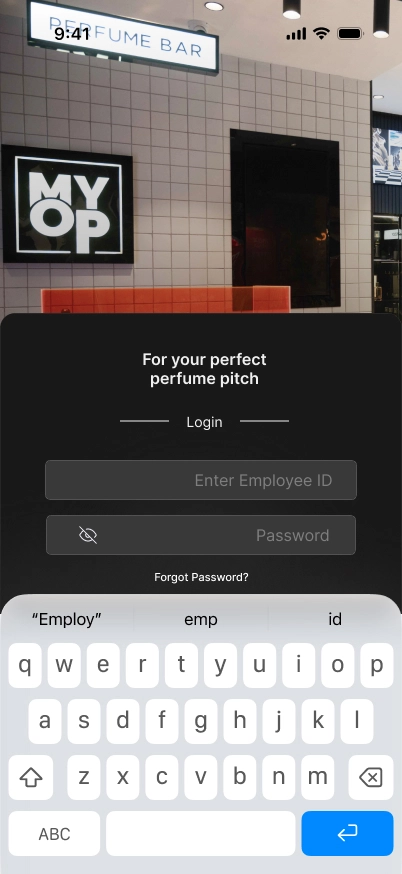
Minimal Inputs
Reduces friction to logging in.
Focused Layout
Avoids distraction and focuses solely on access.
OUTCOMES
Store Scale
Scaled to 74 retail stores across India, making it one of MYOP's most widely adopted internal tools since launch.
Structured Reference
Replaced an informal WhatsApp-based reference system — giving 100–300 sales staff a structured, always-accessible product knowledge tool for the first time.
Staff Adoption
Received positive feedback from staff and store managers, particularly around ease of use during live customer interactions.
Self-Serve Training
Reduced dependency on senior staff for on-floor training by giving new joiners a self-serve learning tool they could reference independently.